Home
Weather Dublin
WeatherRadar
RainfallRadar
TemperatureRadar
WindRadar
LightningRadar
Weather News
Editor's Pick
Discover the app
Weather widget
Contact us
Apps
    Home / Editor's Pick /

    Weather explainer: How do thunderstorms develop?

07:00
6 May 2023

Weather explainer
How do thunderstorms develop?

Lightning

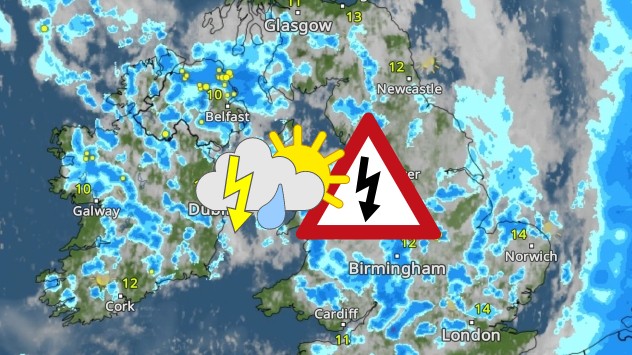
Thunderstorms have been bubbling up across the UK, but how do they actually develop?

They begin to form when warm air lies under colder air in an unstable atmosphere. The warm air will then rise quickly and condense into water droplets to form a cumulonimbus cloud.

Within the cloud, the warm air and water droplets continue to rise and will eventually freeze into positively charged ice crystals. When the ice crystals are heavy enough, they begin to fall as hail.

As the hail falls, it becomes negatively charged. The negatively charged pieces of hail at the base of the cloud then become attracted to the positively charged Earth's surface.

When the attraction is strong enough, the charges come together creating a flash of lightning. It is the rapid expansion and heating of the air which causes the claps of thunder.

Watch our weather explained video below to find out more about how thunderstorms develop:

More on the topic
Cooler nights and lower dew points. Less oppressive heatwave. . . Thursday 9 July 2026
Split image showing the London skyline in hazy golden sunset light in the left and an overnight temperature map of the UK and Ireland on the right, with minimum temperatures ranging from 13°C in northeast Scotland to 18°C in southern England.
Thursday 9 July 2026

Less oppressive heatwave

Cooler nights and lower dew points
The monsoon has India firmly in its grip. Severe thunderstorms. . . Thursday 9 July 2026
Satellite map of South Asia showing the weather situation over India. An arrow marks a low-pressure system over western and central India, which is causing heavy showers and thunderstorms. Thick clouds and rainfall extend across large parts of India as far as the Himalayas and into Bangladesh. Over Pakistan and south-eastern Iran, however, it is mainly sunny and hot, with temperatures exceeding 40 degrees.
Thursday 9 July 2026

Severe thunderstorms

The monsoon has India firmly in its grip
Lee waves flow over the UK and Ireland. On the WeatherRadar. . . Monday 6 July 2026
Satellite weather map of the UK and Ireland showing parallel bands of low cloud highlighted over southern Scotland and northern England, with additional cloud streets over Wales and western England circled in white.
Monday 6 July 2026

On the WeatherRadar

Lee waves flow over the UK and Ireland
All weather news
This might also interest you
Turbulent weather in the Canary Islands. Storm and rain. . . Friday 12 December 2025
Weather graphic showing rain and wind fields over the Canary Islands and a central warning symbol.
Friday 12 December 2025

Storm and rain

Turbulent weather in the Canary Islands
Bright and warm conditions take hold. Spring-like outlook. . . Thursday 23 April 2026
Split UK map showing warm temperatures up to 21 degrees in orange on the left and clear sunny conditions with temperatures from 12 to 18 degrees on the right, with sun icons across the country.
Thursday 23 April 2026

Spring-like outlook

Bright and warm conditions take hold
Super Typhoon Bavi threatens Taiwan. Up to 1,000 mm of rain. . Weather Videos. Wednesday 8 July 2026
The image shows an intense tropical cyclone over the western Pacific, east of Taiwan and the Philippines. The centre of the system is depicted as a light purple and white vortex with a clearly visible eye, surrounded by a ring of red and orange areas indicating the strongest wind speeds. A white arrow marks the typhoon’s predicted track towards the north-west, in the direction of Taiwan. To the west of the storm lie the Philippines, with the cities of Manila and Cebu; to the north of these lies Taiwan, with Taipei. Further west, the Chinese coast, including Hong Kong, and parts of Vietnam can be seen. The coloured wind map shows predominantly green areas outside the storm’s core, indicating significantly weaker winds. White streamlines illustrate the typhoon’s anti-clockwise circulation in the Northern Hemisphere. The highest wind speeds are concentrated around the eye of the cyclone.
Weather VideosWednesday 8 July 2026

Up to 1,000 mm of rain

Super Typhoon Bavi threatens Taiwan
All articles
Weather & Radar

Weather & Radar is also available on

Google Play StoreApp Store

Company

Contact us Privacy Policy Legal info Accessibility statement

Services

Uploader

Socials

facebooktwitteryouTubelinkList