Home
Weather Dublin
WeatherRadar
RainfallRadar
TemperatureRadar
WindRadar
LightningRadar
Weather News
Editor's Pick
Discover the app
Weather widget
Contact us
Apps
    Home / Weather News /

    Flooding disaster in Central Europe

13:40
17 September 2024

Storm Boris
Flooding disaster in Central Europe

What has happened?

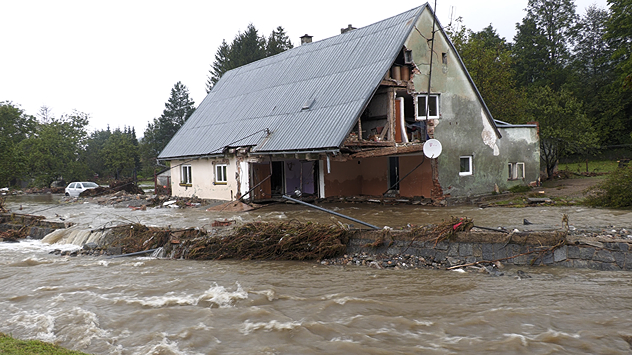
A devastating storm unleashed torrential rain and produced fatal flooding across parts of Central Europe in recent days. Several months of rain fell in just a few days, while heavy snow blanketed Alpine regions.

The death toll has reached at least 17 so far, with thousands more displaced. Countries including the Czech Republic, Austria, Poland, Romania, Hungary, south-east Germany and Slovakia have experienced some of the worst flooding in decades.

The flood risk is set to continue and perhaps even worsen in the coming days, as rivers continue to flood and burst their banks, with bridges disappearing. The Danube River, for example, is rising by around one metre every 24 hours.

1/4
The storms raged over the weekend, 14th and 15th September.

It will take several days for the river levels to drop, with the high temperatures also exacerbating the Alpine snow melt at higher altitudes, leading to continued flooding downstream.

Intense early season snowfall for Alpsread more

Why did this occur?

The devastation in the wake of Storm Boris can be attributed to a culmination of factors.

The Mediterranean Sea has been exceptionally warm in recent months with heat records broken. The warmer the water, the more fuel available as energy for a storm as the water evaporates.

Meanwhile, to the north, there has been an arctic blast of cold air as the jet stream plunged south.

Along this boundary of warm and cold air clashing, there was a sharp temperature gradient ripe for weather fronts.

Storm Boris formed along this boundary, stalling over Central Europe as it gained energy from the warm surrounding sea.

The amount of precipitation was then exacerbated due to an orography as nearby mountain ranges forced this warm, moist air upwards.

More on the topic
Stronger winds make a return. Low pressure influence. . . Tuesday 4 August 2026
Wind forecast map of the UK and Ireland showing a low-pressure system north of Scotland, a windsock icon highlighting blustery conditions, and widespread winds of 30–40 mph across the British Isles, with the strongest winds around Ireland and northern Britain.
Tuesday 4 August 2026

Low pressure influence

Stronger winds make a return
Late season views as summer rolls on. Your weather - Your shots. . . Sunday 9 August 2026
Split image showing a horseback ride along a green hillside trail beneath blue skies on the left and a small sailboat on a calm coastal bay under broken clouds on the right.
Sunday 9 August 2026

Your weather - Your shots

Late season views as summer rolls on
Japan braces itself for Typhoon Dolphin. Landslides feared. . . Wednesday 5 August 2026
Weather map showing a typhoon south of Japan. The centre of the storm is over the Pacific and is moving westwards. The coloured wind fields indicate its high intensity.
Wednesday 5 August 2026

Landslides feared

Japan braces itself for Typhoon Dolphin
All weather news
This might also interest you
Long-term trends need a pinch of salt. 40 °C in July?. . . Tuesday 30 June 2026
Temperature radar of 2022 heatwave where the all-time temperature record in the UK was set. Warning symbol overlain.
Tuesday 30 June 2026

40 °C in July?

Long-term trends need a pinch of salt
Super Typhoon Bavi threatens Taiwan. Up to 1,000 mm of rain. . Weather Videos. Wednesday 8 July 2026
The image shows an intense tropical cyclone over the western Pacific, east of Taiwan and the Philippines. The centre of the system is depicted as a light purple and white vortex with a clearly visible eye, surrounded by a ring of red and orange areas indicating the strongest wind speeds. A white arrow marks the typhoon’s predicted track towards the north-west, in the direction of Taiwan. To the west of the storm lie the Philippines, with the cities of Manila and Cebu; to the north of these lies Taiwan, with Taipei. Further west, the Chinese coast, including Hong Kong, and parts of Vietnam can be seen. The coloured wind map shows predominantly green areas outside the storm’s core, indicating significantly weaker winds. White streamlines illustrate the typhoon’s anti-clockwise circulation in the Northern Hemisphere. The highest wind speeds are concentrated around the eye of the cyclone.
Weather VideosWednesday 8 July 2026

Up to 1,000 mm of rain

Super Typhoon Bavi threatens Taiwan
Flooding, gales, and heavy snow. Storm Chandra. . . Tuesday 27 January 2026
Split image showing aerial flooding in a town with muddy water covering roads on the left, and a rural road on the right blocked by heavy snowfall with vans stopped and a person walking in snow.
Tuesday 27 January 2026

Storm Chandra

Flooding, gales, and heavy snow
All articles
Weather & Radar

Weather & Radar is also available on

Google Play StoreApp Store

Company

Contact us Privacy Policy Legal info Accessibility statement

Services

Uploader

Socials

facebooktwitteryouTubelinkList