Home
Weather Dublin
WeatherRadar
RainfallRadar
TemperatureRadar
WindRadar
LightningRadar
Weather News
Editor's Pick
Discover the app
Weather widget
Contact us
Apps
    Home / Editor's Pick /

    Droughts and floods: Global consequences of El Niño

08:00
25 November 2023

Droughts and floods
Global consequences of El Niño

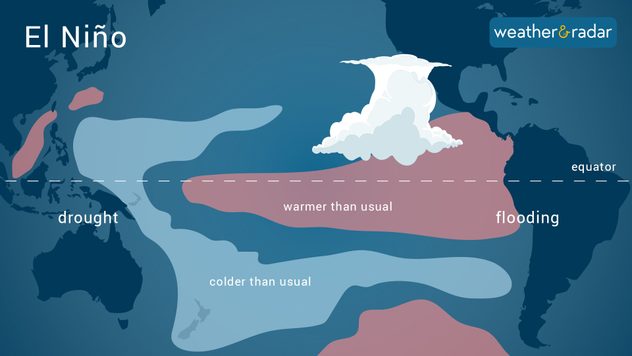
Here, the central and eastern Pacific warms, experiencing more rainfall than normal, while the western Pacific cools and sees drier conditions.

We are in the midst of an El Niño year. This will have a global impact on the weather in the coming months.

The El Niño climate phenomenon is currently approaching its peak. Among other things, it is characterised by a warming of the sea surface temperatures in the Pacific. Currently there, it is as much as 2 degrees warmer than the climate average.

This has knock-on consequences for many parts of the world, some of which are already visible. Some parts of the world will see enhanced rainfall, others drought.

Consequences not only for the Pacific

Some countries bordering the Pacific, such as Peru, Australia and Indonesia, are often the hardest hit. However, El Niño has also had significant effects in Africa in past events.

In the Horn of Africa, for example in Somalia, there have been repeated torrential downpours and flooding. Just a few days ago, over 100 people died in floods there. This was preceded by one of the worst droughts in decades.

Impacts in the Horn of Africaread more

Theories on the origin of El Niño

There is still speculation about the causes of the El Niño phenomenon. Some researchers attribute its origin to solar flares.

These are accompanied by huge discharges of energy on the surface of the sun. We are currently in a phase of high solar activity. This is also one reason why we are currently seeing more auroras.

Weather & Radar editorial team
More on the topic
Widespread thunderstorm risk in the UK. Heavy rain and hail too. . . Tuesday 25 August 2026
Split weather graphic showing a yellow thunderstorm warning across much of England alongside radar with heavy showers and frequent lightning around London and southeast England.
Tuesday 25 August 2026

Heavy rain and hail too

Widespread thunderstorm risk in the UK
2026/27 storm names released. Names to look out for. . . Tuesday 1 September 2026
Lightning strikes beneath dark storm clouds over fields, with warning signs for thunderstorms and strong winds shown in foreground.
Tuesday 1 September 2026

Names to look out for

2026/27 storm names released
Blood Moon rises early Friday morning. Partial lunar eclipse. . . Thursday 27 August 2026
Stages of a lunar eclipse
Thursday 27 August 2026

Partial lunar eclipse

Blood Moon rises early Friday morning
All weather news
This might also interest you
New records for England and Wales. Broken again tomorrow?. . . Thursday 25 June 2026
Temperature map of southwest Britain on 25.06 showing extreme heat across southern Wales and southwest England, with Bute Park in Cardiff highlighted at 34.2°C and Yeovilton at 36.4°C amid widespread deep red heat zones.
Thursday 25 June 2026

Broken again tomorrow?

New records for England and Wales
A frozen start to the weekend. Icy conditions. . . Friday 13 February 2026
UK temperature map dated 14.02 showing widespread subzero values in blue shading, with readings such as −4 in Glasgow, −3 in Dublin, and −2 in London, alongside a blue thermometer icon.
Friday 13 February 2026

Icy conditions

A frozen start to the weekend
Super Typhoon Bavi threatens Taiwan. Up to 1,000 mm of rain. . Weather Videos. Wednesday 8 July 2026
The image shows an intense tropical cyclone over the western Pacific, east of Taiwan and the Philippines. The centre of the system is depicted as a light purple and white vortex with a clearly visible eye, surrounded by a ring of red and orange areas indicating the strongest wind speeds. A white arrow marks the typhoon’s predicted track towards the north-west, in the direction of Taiwan. To the west of the storm lie the Philippines, with the cities of Manila and Cebu; to the north of these lies Taiwan, with Taipei. Further west, the Chinese coast, including Hong Kong, and parts of Vietnam can be seen. The coloured wind map shows predominantly green areas outside the storm’s core, indicating significantly weaker winds. White streamlines illustrate the typhoon’s anti-clockwise circulation in the Northern Hemisphere. The highest wind speeds are concentrated around the eye of the cyclone.
Weather VideosWednesday 8 July 2026

Up to 1,000 mm of rain

Super Typhoon Bavi threatens Taiwan
All articles
Weather & Radar

Weather & Radar is also available on

Google Play StoreApp Store

Company

Contact us Privacy Policy Legal info Accessibility statement

Services

Uploader

Socials

facebooktwitteryouTubelinkList