Home
Weather Dublin
WeatherRadar
RainfallRadar
TemperatureRadar
WindRadar
LightningRadar
Weather News
Editor's Pick
Discover the app
Weather widget
Contact us
Apps
Home / Editor's Pick /

Annual astro highlight: Perseid Meteor Shower to peak tonight

15:00
12 August 2023

Annual astro highlight
Perseid Meteor Shower to peak tonight

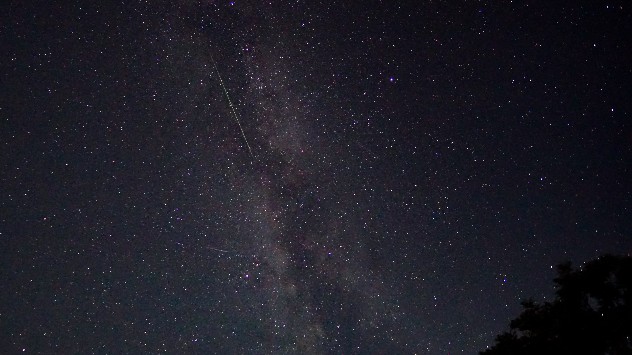
Shooting starA shooting star from the Perseids spotted in Harzgerode, Germany earlier this week. - © Torsten Brehme

One of the year's most active meteor showers is set to peak tonight, and with a new moon approaching soon, the night sky will be perfect for spotting shooting stars.

The Perseid Meteor Shower can produce up to 100 meteors an hour on particularly active years. We are set to see the peak overnight. While they will be visible from sunset, the best hours arrive between midnight and 05:30 am.

From the UK and Ireland, the radiant will appear from the Perseus constellation. After midnight, the Earth will have rotated to face the shower offering the most and brightest shooting stars.

Weather outlook

Saturday is marked by scattered showers and overcast conditions. By sunset, rain begins to clear in most areas, though some pockets remain by midnight with light clouds elsewhere.

By the early hours of Sunday morning the clearest skies can be found in southern Ireland, northeastern to central England, plus the far north and southwest of Scotland.

Tips for stargazing

For the best chance to see a meteor, find a dark area away from light pollution. Ideally in the countryside away from towns.

Specks of dust create the show

The nocturnal celestial spectacle is caused by the dust plume of the Comet Swift-Tuttle, which passes the earth every year in August.

When the dust particles, which are only millimetres in size, hit the upper layers of the Earth's atmosphere at a speed of 37 miles per second, they are abruptly slowed down and heated to white heat.

The particles then burn up in fractions of a second and paint their luminous trail on the night sky.

This constellation can be seen after dark in the northeast sky. The constellation Cassiopeia above Perseus helps with orientation. However, the shooting stars can also spread all over the sky.

Ryan Hathaway
More on the topic
Split image showing a rainfall anomaly map with wetter-than-average conditions over the UK on the left, and a reservoir with very low water levels and exposed banks on the right.
Thursday 26 March 2026

Rainy winter help

England is officially drought-free
Split image showing a warning map of the UK and Ireland on the left and a wind forecast map on the right with strong gusts around 40–55 mph, overlaid with a windsock warning symbol.
Tuesday 24 March 2026

Gales return

Increasingly gusty into midweek
The image shows the central Pacific in a computer model. A striking feature is the ocean coloured red, which indicates very warm seawater.
Tuesday 24 March 2026

Global consequences

El Niño is back
All weather news
This might also interest you
Split weather map showing UK wind speeds in orange-red shades up to 40 mph on the left and warning levels in green-yellow on the right, with a central wind warning sign.
Wednesday 22 October 2025

Warnings active

Storm Benjamin impacts the UK
plit image showing a double rainbow over a rocky shoreline on the left and sheep grazing in a green field under stormy clouds on the right.
Sunday 2 November 2025

Your weather - Your shots

Mixed conditions on an unsettled week
Weather graphic showing rain and wind fields over the Canary Islands and a central warning symbol.
Friday 12 December 2025

Storm and rain

Turbulent weather in the Canary Islands
All articles
Weather & Radar

Weather & Radar is also available on

Google Play StoreApp Store

Company

Contact us Privacy Policy Legal info Accessibility statement

Services

Uploader

Socials

facebooktwitteryouTubelinkList