Home
Weather Dublin
WeatherRadar
RainfallRadar
TemperatureRadar
WindRadar
LightningRadar
Weather News
Editor's Pick
Discover the app
Weather widget
Contact us
Apps
Home / Editor's Pick /

Understanding the different types of winter precipitation

16:00
26 February 2022

Winter weather education
Do you know your winter precipitation?

ice after freezing rain covers car

Winter storms are notorious for their dangerous wintry precipitation. Heavy snow, sleet, and ice can all have significant consequences on our everyday lives. This article will dive into the different types of wintry precipitation, how to differentiate them, and under what conditions they form.

Freezing Rain

Freezing rain is often the most dangerous kind of winter precipitation. This is because it does not freeze until it hits the ground, turning roads and other surfaces into a slippery ice sheet. It could also cause power outages and topple trees due to the ice's added weight on powerlines and branches.

Sleet

Like freezing rain, sleet forms when liquid raindrops fall from a layer of warm air into a layer of freezing air that hugs the surface. However, in contrast to freezing rain, the freezing air layer is much thicker during a sleet event, allowing the raindrops to freeze into transparent ice pellets before reaching the ground.

Sleet is as dangerous as freezing rain as it tends to accumulate into a slushy or frozen layer on surfaces. Freezing rain and sleet can be tracked on the WeatherRadar and is highlighted by the area in pale orange.

Snow

This is the kind of precipitation that we all think of when dealing with a winter storm. In most cases, snow reaches the ground when the entire column of air between the cloud and ground is below freezing. Heavy snow occurs when there is a lot of moisture in the atmosphere, which is usually the case during the strongest storm systems.

Graupel

Graupel is the least-known type of winter precipitation and is often mistaken with hail. Graupel is best described as soft, small pellets that form when supercooled water droplets (at a temperature below 0C) freeze onto a snow crystal—a process called riming. Unlike hail, which can grow several inches in diameter, the more brittle graupel is usually less than one-fifth of an inch in diameter.

Rain

Winter storms can also bring heavy rain, especially to areas south of the storm where temperatures tend to stay warmer. Rain will either start as a liquid drop or snow in the upper levels of the atmosphere and then reach the surface as liquid because temperatures on the ground are above freezing.

Weather & Radar editorial team
More on the topic
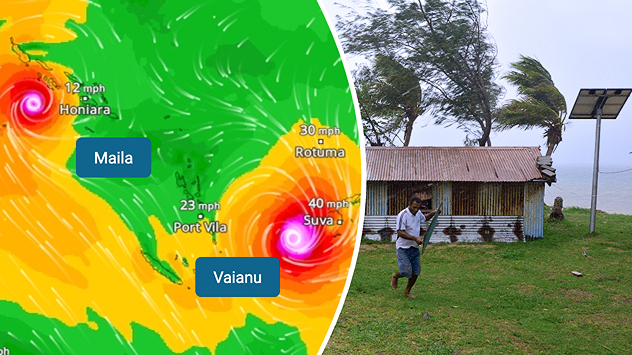
Two cyclones are currently threatening the South Sea islands off the coast of Australia.
Monday 6 April 2026

Solomon Islands and Fiji

Cyclones threaten South Pacific islands
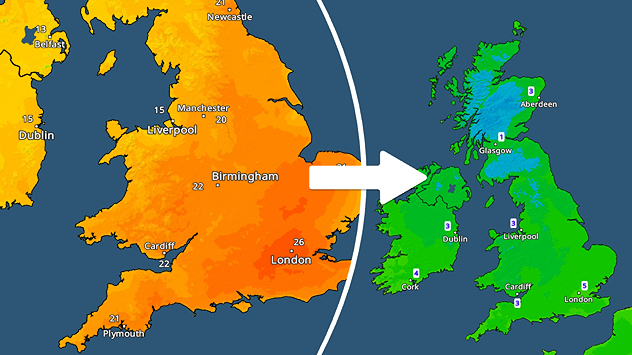
Split UK map showing warm orange temperatures up to 26 degrees on the left transitioning to cooler green tones around 3 to 5 degrees on the right, with an arrow indicating change.
Wednesday 8 April 2026

A quick shift

High of the year to a cooler spell
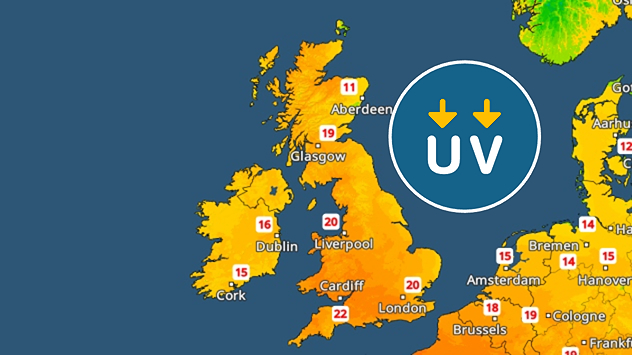
UK and Ireland map shaded in warm tones showing UV levels, with values up to 22 in southern England and lower values in Scotland, plus a circular UV icon.
Tuesday 7 April 2026

Sunscreen season

UV levels rising with the warmth
All weather news
This might also interest you
Outline of Santa Claus with a yellow and white hat, "Ho-Ho-Ho" next to the outline above a Christmas tree.
Thursday 25 December 2025

Merry Christmas!

Wishes from Weather & Radar
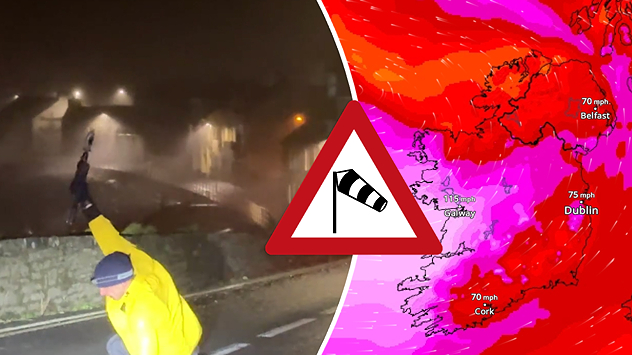
Split image showing a person in a yellow jacket struggling against strong winds and heavy rain on a street at night on the left, and an Irish wind forecast map on the right with red and purple shading, gusts up to 75 mph, and a wind warning icon, divided by a curved white line.
Saturday 24 January 2026

On this day...

Historic Storm Éowyn arrives
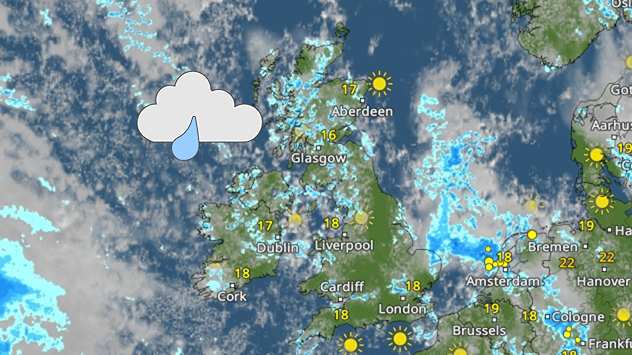
Weather map of the UK and Ireland showing scattered showers with cloudy patches across much of the region, especially around western and northern areas. Sunshine symbols appear over London, Cardiff, and parts of southern England, while temperatures range from 17°C to 18°C in most places. Areas of heavier rain are visible over the Atlantic to the west.
Friday 29 August 2025

Breakfast brief

Unsettled conditions into the weekend
All articles
Weather & Radar

Weather & Radar is also available on

Google Play StoreApp Store

Company

Contact us Privacy Policy Legal info Accessibility statement

Services

Uploader

Socials

facebooktwitteryouTubelinkList