Home
Weather Dublin
WeatherRadar
RainfallRadar
TemperatureRadar
WindRadar
LightningRadar
Weather News
Editor's Pick
Discover the app
Weather widget
Contact us
Apps
Home / Editor's Pick /

Temperature differences: Why is it warmer at the coast?

14:00
12 October 2022

Temperature differences
Why is it warmer at the coast?

england beach

As we head into autumn and winter, a notable temperature difference becomes apparent between inland and coastal areas, but why is that?

Through the spring and summer months, inland or land-locked areas are notoriously warmer than coastal areas, whilst during the autumn and winter, the opposite is true.

This is because of something called specific heat capacity, which is the amount of heat a material is capable of holding. Water has a higher specific heat capacity than land, which means that it can hold more heat.

Bodies of water take longer to heat up and cool down, so absorb all the heat through the spring and summer months, when the sun is at its strongest, and then lose that heat slower through autumn and winter, once it starts cooling down.

For land on the other hand, it heats up and cools down much quicker. So during the spring and summer months the ground quickly absorbs solar radiation, consequently also warming the layer of air above it. Whereas in winter, it quickly loses all of that heat back out to the atmosphere.

As a result, areas along the coast, or near large bodies of water, will retain that warmth thanks to the sea breeze effect. When air blows over land from the water, it warms those nearby areas, before the air then cools as it travels further inland.

Of course if the wind direction is off-shore then this is not the case however, but with our prevailing westerly winds, coastal parts of Wales and the west coasts of England, and also Ireland, will often remain a few degrees higher than areas further inland as we head into the colder months.

So, if you're looking for a less cold weekend staycation over the next few months, your best bet is to head there!

Weather & Radar editorial team
More on the topic
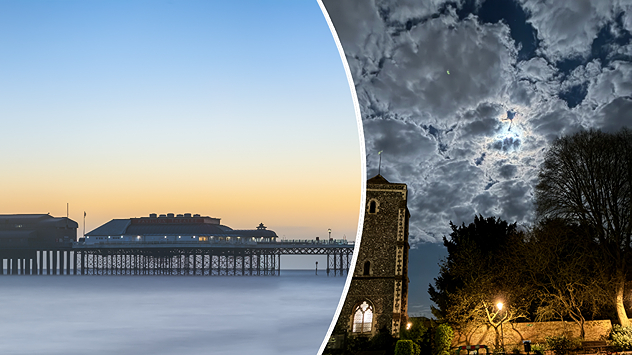
Split image with Cromer Pier at sunset on the left in soft orange-blue tones and a moonlit Canterbury church with dramatic clouds on the right, lit by a streetlamp.
Sunday 5 April 2026

Your weather - Your shots

Spring captured after the clock change
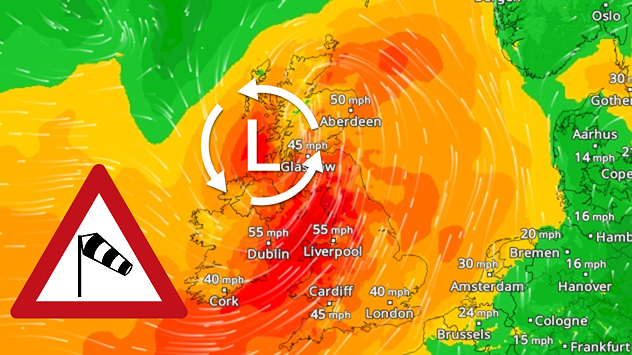
Wind map of the UK and Ireland showing a deep low-pressure system, Storm Dave, with red-orange zones and strong gusts up to 55 mph, plus a windsock warning icon indicating hazardous conditions.
Saturday 4 April 2026

Severe overnight gales

Storm Dave makes impact
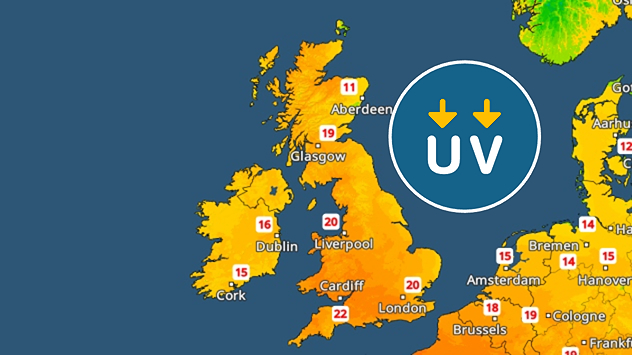
UK and Ireland map shaded in warm tones showing UV levels, with values up to 22 in southern England and lower values in Scotland, plus a circular UV icon.
Tuesday 7 April 2026

Sunscreen season

UV levels rising with the warmth
All weather news
This might also interest you
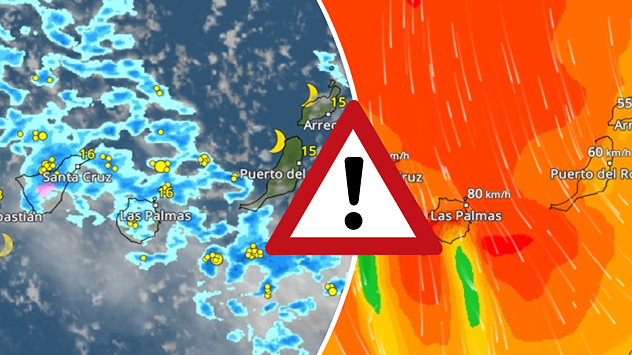
Weather graphic showing rain and wind fields over the Canary Islands and a central warning symbol.
Friday 12 December 2025

Storm and rain

Turbulent weather in the Canary Islands
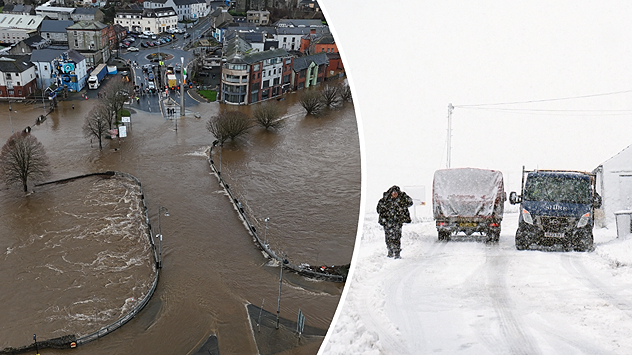
Split image showing aerial flooding in a town with muddy water covering roads on the left, and a rural road on the right blocked by heavy snowfall with vans stopped and a person walking in snow.
Tuesday 27 January 2026

Storm Chandra

Flooding, gales, and heavy snow
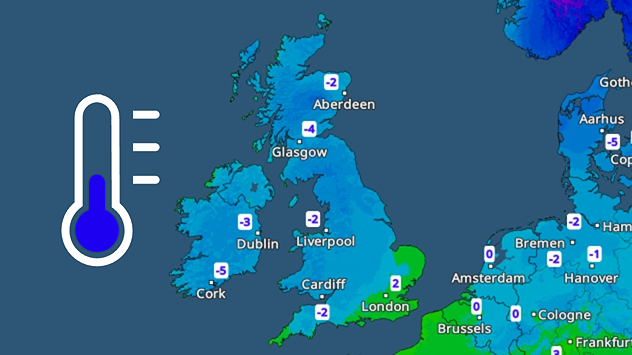
UK temperature map dated 14.02 showing widespread subzero values in blue shading, with readings such as −4 in Glasgow, −3 in Dublin, and −2 in London, alongside a blue thermometer icon.
Friday 13 February 2026

Icy conditions

A frozen start to the weekend
All articles
Weather & Radar

Weather & Radar is also available on

Google Play StoreApp Store

Company

Contact us Privacy Policy Legal info Accessibility statement

Services

Uploader

Socials

facebooktwitteryouTubelinkList