Home
Weather Dublin
WeatherRadar
RainfallRadar
TemperatureRadar
WindRadar
LightningRadar
Weather News
Editor's Pick
Discover the app
Weather widget
Contact us
Apps
Home / Editor's Pick /

Solar maximum in 2024: Sun activity rising faster than expected

15:00
23 July 2023

Solar maximum in 2024
Sun activity rising faster than expected

Solar activityAn active area of the sun during the previous solar cycle in 2018. - © NASA/GSFC/Solar Dynamics Observatory

Solar activity is becoming increasingly volatile as the sun approaches its solar maximum earlier than expected.

The sun is in a constant cycle of activity, each solar cycle lasts for around 11 years, with the most volatile stage known as the solar maximum.

Previously, this was expected to arrive in mid-2025. A rise in activity in recent weeks has seen astronomers bring this forecast forward to mid- to late-2024.

When the solar maximum occurs the sun’s magnetic field flips, there is an increase in the number of sunspots, areas where the sun’s magnetic field is much stronger, and solar flares.

If these flares are fired in the direction of Earth, they interact with the atmosphere on arrival and create vibrant auroras.

Earlier this week, two coronal mass ejections (CME) were observed to be ejected by sunspots in our planet’s direction.

The first was launched July 14 and was followed a day later by a larger, faster travelling ejection. This resulted in a rare cannibal CME where the first was consumed by the second.

Flare or CME?

A solar flare is a burst of electromagnetic radiation which can reach Earth in eight minutes. CMEs are an expulsion of plasma from the sun's atmosphere and can take days to arrive.

Larger solar storms also see auroras spread to more southern latitudes. The cannibal CME this week means that auroras were visible over Scotland and areas of northern England.

Events such as these can interrupt radio signals on Earth, and satellites are also at risk. In February 2022, a solar storm destroyed 40 Starlink satellites launched by Elon Musk’s SpaceX.

Ryan Hathaway
More on the topic
A harbour in Crete with a reddish-brown, overcast sky
Friday 3 April 2026

Blood red skies

Dust storm in Crete
Pink-blossoming cherry trees lining a street next to the weather radar, with sunshine and temperatures around 19 degrees near Bonn.
Weather VideosTuesday 7 April 2026

Cherry blossoms in Bonn

Spring bloom on show
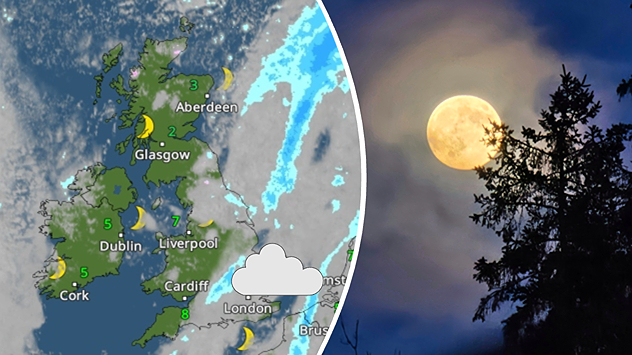
Split image with UK nighttime weather map on the left showing clouds, rain bands, and temperatures, and a bright full moon above dark pine trees on the right.
Wednesday 1 April 2026

Good visibility for most

The Pink Moon rises tonight
All weather news
This might also interest you
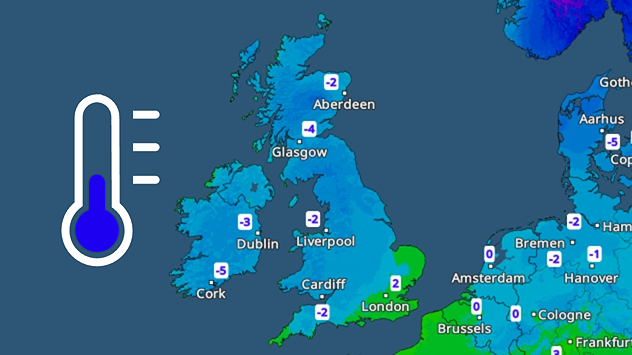
UK temperature map dated 14.02 showing widespread subzero values in blue shading, with readings such as −4 in Glasgow, −3 in Dublin, and −2 in London, alongside a blue thermometer icon.
Friday 13 February 2026

Icy conditions

A frozen start to the weekend
Illustration of white and yellow fireworks on a blue background.
Wednesday 31 December 2025

Hello 2026

Happy New Year
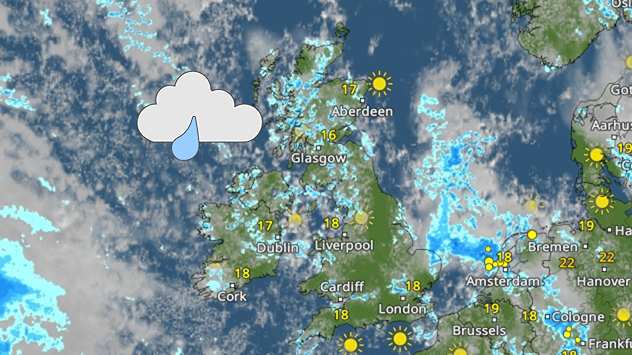
Weather map of the UK and Ireland showing scattered showers with cloudy patches across much of the region, especially around western and northern areas. Sunshine symbols appear over London, Cardiff, and parts of southern England, while temperatures range from 17°C to 18°C in most places. Areas of heavier rain are visible over the Atlantic to the west.
Friday 29 August 2025

Breakfast brief

Unsettled conditions into the weekend
All articles
Weather & Radar

Weather & Radar is also available on

Google Play StoreApp Store

Company

Contact us Privacy Policy Legal info Accessibility statement

Services

Uploader

Socials

facebooktwitteryouTubelinkList