Home
Weather Dublin
WeatherRadar
RainfallRadar
TemperatureRadar
WindRadar
LightningRadar
Weather News
Editor's Pick
Discover the app
Weather widget
Contact us
Apps
Home / Editor's Pick /

Hunga Tonga impacts: Will the eruption alter our winter?

10:00
4 October 2022

Hunga Tonga impacts
Will the eruption alter our winter?

Hunga Tonga eruption on the satellite, alongside London in the snow© NASA satellite imagery of the Hunga Tonga eruption (left)

On January 15th 2022, the strongest volcanic eruption in recent history took place in the South Pacific. However, research suggests that the Hunga Tonga eruption could in fact determine our weather this winter.

It is now thought that the Hunga Tonga eruption might affect Earth's climate, following research from a team at the California Institute of Technology this summer. Since the eruption released little sulphur dioxide, scientists assumed that the normal cooling effect of large volcanic eruptions would hardly be felt.

However, the volcano also emitted unusually large amounts of water vapour into the stratosphere, which could have the opposite effect. This is because water vapour is a very powerful greenhouse gas, and any significant increase in it would inevitably lead to warming of the lower layers of the atmosphere.

A measurable cooling would then be expected in the upper, dry stratosphere, which is what researchers have been able to prove; the beginning of a large-scale cooling of the stratosphere over Earth's southern hemisphere.

This stratospheric cooling has now reached unprecedented levels, and this effect could spread into the northern hemisphere over the coming months.

This may affect the behaviour of a phenomenon called the North Atlantic Oscillation (NAO), increasing the tendency to develop a negative NAO index. This would mean that the pressure difference between the low-pressure area near Iceland and the Azores high will decrease, leading to more blocking weather patterns in Europe.

Blocking flow patterns in the winter months can often, but not always, lead to rather cold weather conditions in north-west Europe.

However, because the Hunga Tonga submarine volcanic eruption is a complex phenomenon that has not yet been observed on a large scale, any conclusions drawn from this event should be interpreted with great caution.

Because on the flip side, a permanently blocking high-pressure area could also lead to a very mild winter, if, for example, it anchors over south-eastern Europe, instead of over the British Isles. Additionally, the expected effects on the NAO could be delayed or postponed until spring, so winter could be more Atlantic driven, i.e. mild and humid.

So, the question on this winter remains open, with only tentative possibilities based on the scarce findings from the Tonga eruption.

Weather & Radar editorial team
More on the topic
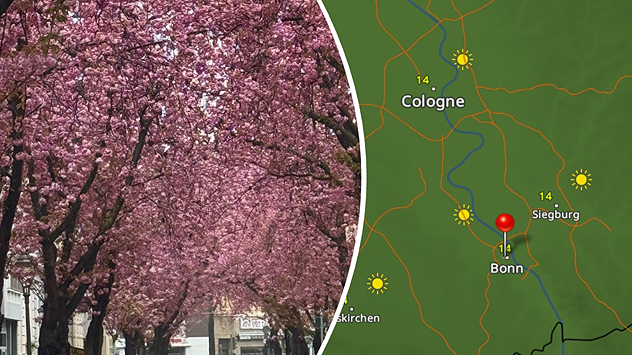
Pink-blossoming cherry trees lining a street next to the weather radar, with sunshine and temperatures around 19 degrees near Bonn.
Weather VideosTuesday 7 April 2026

Cherry blossoms in Bonn

Spring bloom on show
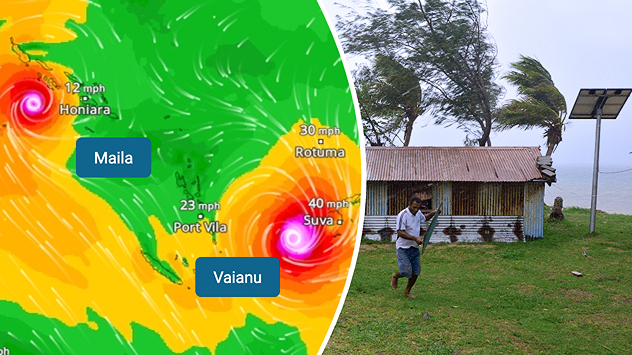
Two cyclones are currently threatening the South Sea islands off the coast of Australia.
Monday 6 April 2026

Solomon Islands and Fiji

Cyclones threaten South Pacific islands
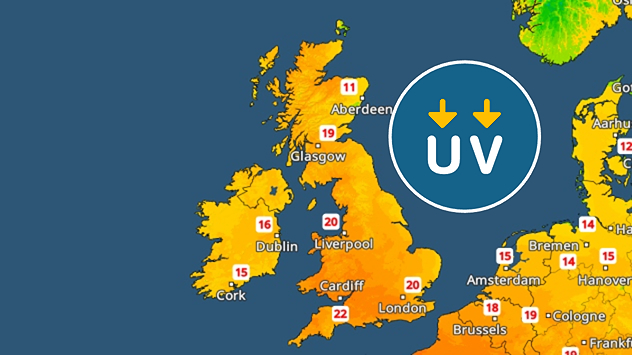
UK and Ireland map shaded in warm tones showing UV levels, with values up to 22 in southern England and lower values in Scotland, plus a circular UV icon.
Tuesday 7 April 2026

Sunscreen season

UV levels rising with the warmth
All weather news
This might also interest you
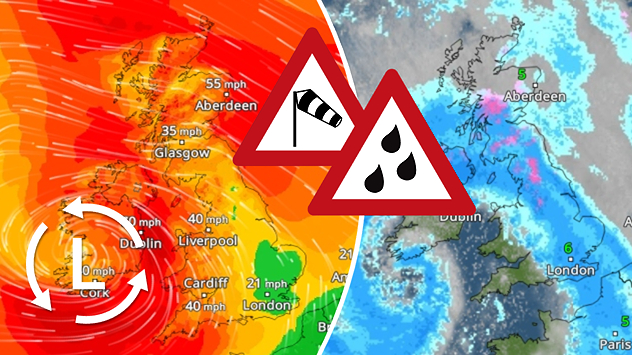
Split image showing strong winds over the UK on a forecast map and widespread rain and snow on a weather radar map.
Tuesday 27 January 2026

Severe gales & heavy rain

Storm Chandra makes impact
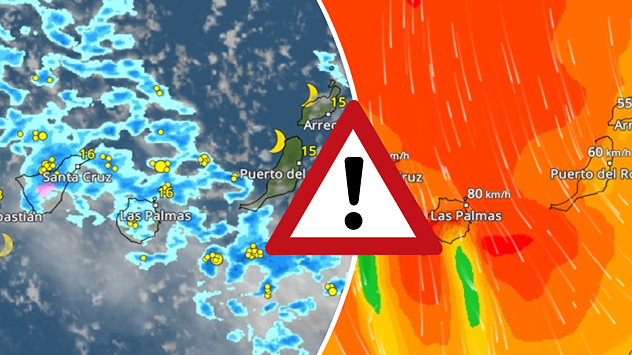
Weather graphic showing rain and wind fields over the Canary Islands and a central warning symbol.
Friday 12 December 2025

Storm and rain

Turbulent weather in the Canary Islands
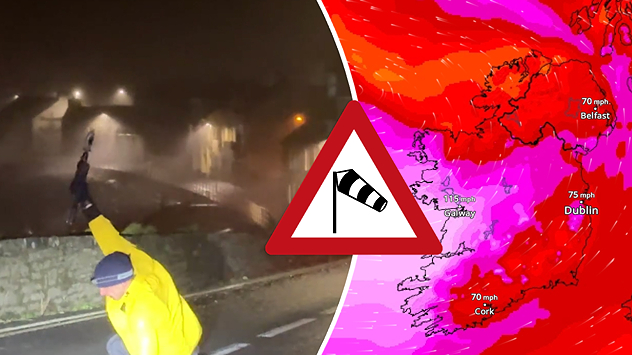
Split image showing a person in a yellow jacket struggling against strong winds and heavy rain on a street at night on the left, and an Irish wind forecast map on the right with red and purple shading, gusts up to 75 mph, and a wind warning icon, divided by a curved white line.
Saturday 24 January 2026

On this day...

Historic Storm Éowyn arrives
All articles
Weather & Radar

Weather & Radar is also available on

Google Play StoreApp Store

Company

Contact us Privacy Policy Legal info Accessibility statement

Services

Uploader

Socials

facebooktwitteryouTubelinkList